
In our latest interview, Daniel Coté, Design Optimization Team Lead at Rexfab, shares how hands-on experience, smart design tools, and 3D visualization help reduce risk, improve project execution, and deliver automation solutions designed right the first time.
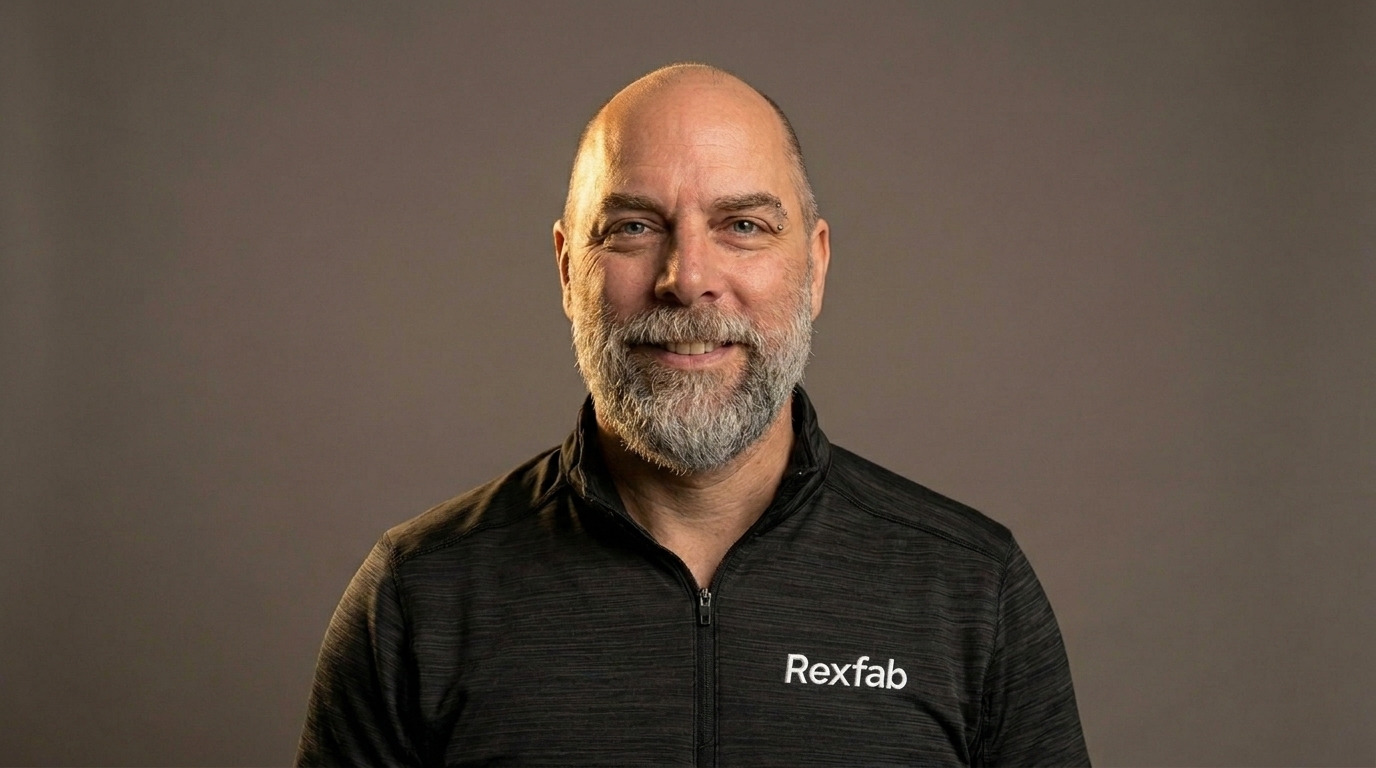
“I wasn’t just supervising installations—I was assembling equipment myself. That kind of hands-on experience is critical. It gives you a firsthand understanding of what works and what doesn’t”.
Why Expertise Matters in Automation Design
Interview with Daniel Coté, Design Optimization Team Lead at Rexfab
Designing automation is not just about drawing conveyors or connecting equipment—it’s about deeply understanding how systems behave in the real world. To explore this, I sat down with Daniel Coté, Design Optimization Team Lead at Rexfab, who shared how hands-on expertise transforms project outcomes for wholesale bakers.
1. From Hands-On Experience to Engineering Excellence
Q: Daniel, can you tell us about your background and how your expertise developed?
Daniel Coté:
I started at Rexfab 20 ago but I started as a mechanical designer in January 2000. I’ve worked for 6 years for a company that rented my mechanical design services to other companies in various sectors.
At the beginning, we did everything—design, client discussions, site measurements, procurement, fabrication drawings, even installation.
I wasn’t just supervising installations—I was assembling equipment myself. That kind of hands-on experience is critical. It gives you a firsthand understanding of what works and what doesn’t.
You learn that a design isn’t just about looking good on paper. It must work for:
- The person fabricating the parts
- The team assembling them
- The crew installing them
- The operators using them
- The sanitation crew
That’s how real expertise is built—by being involved in every step.
2. Designing Beyond the Drawing: Real-World Constraints
Q: What kinds of constraints must engineers consider when designing automation systems?
Daniel:
There are many things you don’t think about unless you’ve lived them:
- Can the equipment fit in a truck?
- How will it be moved inside the plant?
- Does it pass through doors and corridors?
- Can the client’s team install or maintain it easily?
When you’ve experienced installations yourself, you naturally design for these realities.
Q: How do you transfer this expertise across your team?
Daniel:
My role is to develop tools—what we call configurators—that embed our design knowledge directly into the process.
These tools:
- Automatically generate conveyor designs
- Apply all Rexfab design rules
- Integrate supplier constraints (like belt limits, radius, etc.)
- Prevent errors from the start
We often say: “We don’t know what we don’t know.”
These tools ensure that even less experienced designers don’t make critical mistakes.
Why this matters:
For wholesale bakers, this means:
- Consistent quality across every project
- Faster execution
- Fewer costly design errors
Q: Can you give an example of how expertise improves outcomes?
Daniel:
Sure. For example, theoretically, a conveyor might support a very tight radius based on supplier specs. But from experience, we know it won’t work reliably in practice.
So our tools prevent designers from choosing those unrealistic options.
This avoids situations like:
- Parts that can’t be fabricated
- Components that fail during assembly
- Delays at installation
Impact for bakers:
This is critical when:
- Expanding production capacity
- Increasing throughput
- Upgrading legacy systems
- Tight schedule shut down between productions
Expertise ensures first-time-right execution.
5. Speed Without Compromising Quality
Q: How do your tools affect project speed and efficiency?
Daniel:
They allow us to produce designs faster while maintaining quality.
They also:
- Help onboard new designers quickly
- Enable external resources to contribute efficiently
- Allow experienced designers to focus on complex, custom challenges
We essentially improve the classic trade-off:
Faster + Better + More Cost-Effective
For bakey operations:
This means you can:
- Scale production quicker
- Respond to market demand faster
- Reduce project timelines and risk
Q: How do you balance standard components with custom solutions?
Daniel:
We always try to reuse proven components where possible. Sometimes that means using two standard parts joined together instead of creating a new custom one from scratch.
It might seem counterintuitive, but:
- It reduces engineering time
- Improves availability
- Lowers costs
And the final result is just as effective.
Why this matters:
For asset replacement:
You get reliable solutions built from tested components, while still adapting to your specific production needs.
7. Enhancing Collaboration with 3D Visualization
Q: How do clients react when they see your tools in action?
Daniel:
They’re often amazed.
We can:
- Generate full 3D layouts quickly
- Show how lines integrate into their facility
- Update designs instantly based on changes
We can even place the design inside a 3D scan of the client’s plant, detecting potential clashes early.
For whoesale bakers:
This enables:
- Better internal alignment (operations, maintenance, management)
- Faster decision-making
- Reduced project risk
Q: How does this help clients internally?
Daniel:
Clients can share the 3D models with their teams—maintenance, operators, leadership.
People can visualize:
- How they’ll interact with the equipment
- How cleaning and maintenance will work
- Whether workflows improve
For most people It’s much easier than interpreting 2D drawings.
Results for bakery teams:
- Stronger employee buy-in
- Better operational readiness
- Fewer surprises after installation
9. Reducing Risk in Automation Projects
Q: Ultimately, what is the biggest benefit of this approach?
Daniel:
It reduces risk at every stage:
- Design errors are caught early
- Installation issues are minimized
- Decisions are validated before execution
The earlier you catch an error, the cheaper it is to fix.
Critical insight for large bakery investments:
Whether you’re:
- Scaling production
- Adding flexibility
- Replacing aging assets
Expertise embedded in the process protects your investment.
Final Thought: Expertise Is the Hidden Driver of Success
Automation projects in wholesale baking are complex. Success depends not just on equipment, but on the knowledge behind it.
At Rexfab, expertise is:
- Built through hands-on experience
- Captured in intelligent tools
- Shared across teams
- Applied to every project
✅The result:
Flexible, scalable, and reliable solutions—designed right the first time.

Expert Mix Eric Brochu
Éric décrit les méthodes industrielles comme un lien bidirectionnel entre l’ingénierie et la fabrication. Des dessins complets, des côtes et des tolérances claires, des matériaux appropriés et des choix de machines cohérents contribuent à prévenir les interruptions et à réduire l’improvisation. Les estimations des temps de fabrication facilitent la planification, tandis que les commentaires du plancher de production aident l’ingénierie à simplifier les pièces et à réduire les étapes de fabrication ou les coûts des matériaux. La faisabilité des demandes sur mesure est évaluée avant leur mise en production. Ensemble, ces pratiques contribuent à maintenir une qualité constante, à rendre la fabrication plus efficace et à offrir des produits plus compétitifs aux clients.

Expert Mix Kaven Croft
In this Rexfab Experts interview, Kaven Croft, Engineering Systems Director, explains how collaboration, system-wide thinking, and hands-on expertise help turn operational needs into flexible, reliable solutions built for long-term value.

Expert Mix Raphaël Proulx
In this Rexfab Experts interview, Raphaël Proulx shares how nearly a decade of engineering experience has shaped his approach to technical support, customer collaboration, and problem-solving. From equipment design and startup to troubleshooting and after-sales service, Raphaël explains why understanding the full production context is essential to delivering effective, long-term solutions. His role as a Resale Technical Expert also highlights the importance of gathering, analyzing, and translating field information into actionable improvements for customers, Rexfab teams, and technology partners.