
In our latest Inside Rexfab’s Expertise interview, Sébastien Rosa, Programming Team Lead, explains how precision, programming, and commitment create long-term value for bakery manufacturers.
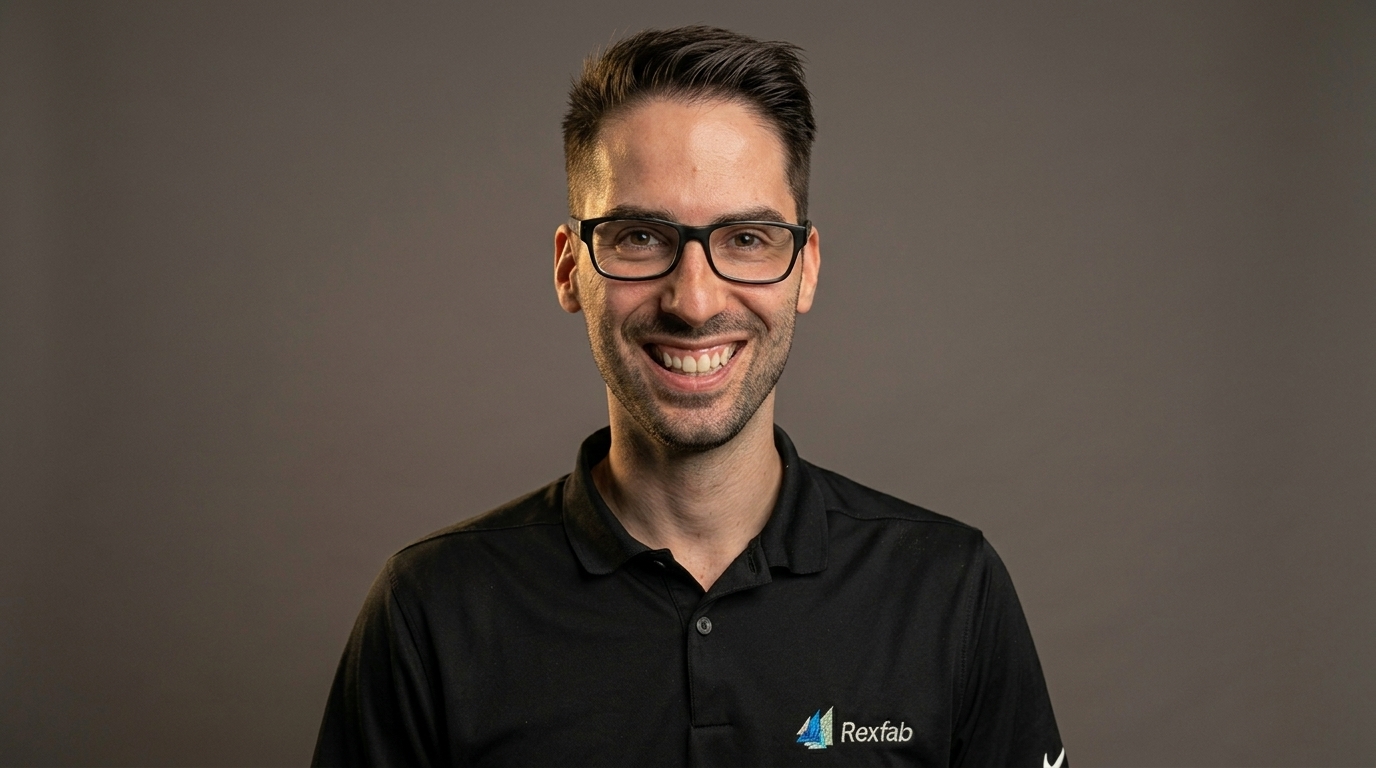
Meet the Expert
Q: Sébastien, can you tell us about yourself and your journey at Rexfab?
Sébastien Rosa:
My name is Sébastien Rosa. I’m 32 years old, and I’ve been working at Rexfab for about seven and a half years now. I joined the company in September 2018 as part of the programming team. After about three years, I stepped into a leadership role, and I’ve now been leading the programming team for roughly five years.
Over that time, I’ve had the opportunity to be involved in many different projects, and what’s interesting is that every one of them builds experience that we carry forward. That accumulation of knowledge is really at the core of how we work today.
Programming at Rexfab: A Role That Spans the Entire Project
Q: What does your role involve on a day-to-day basis?
Sébastien:
What makes programming at Rexfab unique is that we are part of the project from beginning to end. It’s not a situation where we just receive a design and execute it—we actually contribute to shaping the system itself.
In some cases, we are even involved before the quote is finalized. The sales team will come to us and ask how a system should function, what logic is required, and what constraints need to be considered. That input is integrated early, so the quoted solution already reflects a realistic, operational design.
Once the project moves forward, we participate in defining what we call the sequence of operations. This is where we determine exactly how the system should behave. We review everything in detail—what sensors are needed, how motors should operate, how different modes will function, how the system reacts under different conditions.
From there, we support the electrical design by providing all the necessary information to ensure the drawings match the intended functionality. We also validate those drawings before they go to production. At the same time, we begin building the program itself, using a structured base code with modules that have already been tested and proven across previous projects.
This is important because we don’t start from a blank page. Every system we build benefits from what came before it. We reuse, refine, and adapt proven logic, and then add the specific process layer that is unique to each application.
By the time we arrive on site, we already know the system in depth—because we were part of its creation at every stage.
Why Programming Is the Invisible Driver of Performance
Q: Why is programming so important for customers, even if they don’t directly see it?
Sébastien:
Programming is what brings the machine to life. Without it, you just have equipment. With it, you have a system that performs, adapts, and produces reliably.
What makes it critical is that small details in the code can have long-term consequences. A minor oversight might not be obvious during startup, but it could impact production every single day for the next 20 years.
That’s why attention to detail is essential. There’s no such thing as a “small” error. Every logic decision, every condition, every sequence matters. When you multiply a small inefficiency by years of operation, it becomes significant.
So our role is to make sure that nothing is left to chance. Everything must be thought through thoroughly, because what we deliver will define how the system behaves over its entire life cycle.
A Mindset Built on Anticipation and Precision
Q: How do you achieve that level of reliability and precision?
Sébastien:
It starts with mindset. Programming is not just a technical skill—it’s also about how you think.
You have to anticipate all possible scenarios, not just the normal ones. You need to ask yourself: What happens if something unexpected occurs? What if the system behaves differently after years of wear, or after a manual intervention?
You can’t ignore those cases, because eventually they will happen. And if they are not handled, the system will not react correctly.
So it’s about being thorough and disciplined. You can’t accept something that is just “good enough.” You need to go further and make sure that every situation is covered. That’s what ensures long-term stability.
A Defining Difference: Programmers on Site
Q: What distinguishes Rexfab during installation and startup compared to other OEMs?
Sébastien:
One of the biggest differences is that we send programmers on-site during commissioning.
In many companies, the startup is handled mainly by mechanical teams. They ensure everything is installed correctly, which is very important, but when it comes to optimizing how the system behaves, the person with the deepest understanding of the logic is not always there.
When the programmer is on site, everything changes. Instead of reacting to reported issues, we can observe the system in real time, understand what is happening, and immediately translate that into improvements in the logic.
This eliminates delays, avoids miscommunication, and leads to a much higher level of optimization. It’s not just about making the system run—it’s about making it run at its best.
Commitment That Customers Can See
Q: What do clients typically notice when your team is on-site?
Sébastien:
The level of engagement.
We don’t stop when the system is “running.” We keep working until it runs as smoothly and efficiently as possible. Even when everything looks good, we continue analyzing, looking for opportunities to improve.
That could mean making the flow more consistent, reducing wear on equipment, improving transitions between systems, or refining how operators interact with the machine.
Customers often notice that we’re proactive. We don’t wait for problems to appear. We try to identify them before they happen. And that approach creates a much better startup experience and a much better final result.
Seeing Beyond the Machine: A Holistic Approach
Q: You often mention looking at the entire line. Why is that so important?
Sébastien:
Because no system operates in isolation, especially in a bakery.
Take a pan handling system as an example—it’s a closed loop. What happens at one point affects everything else. If you don’t consider the full picture, you can create imbalances that impact the entire production flow.
When we are on site, we analyze the line from the oven discharge all the way back to the moulders. We look at the flow of pans, the interaction between systems, the rate of production, and how everything connects.
If the line is not balanced, you’ll see patterns like running fast, then stopping, then running fast again. That creates unnecessary stress on equipment and reduces overall efficiency.
Our goal is to smooth that out and create a continuous, stable flow.
A Concrete Example: The Impact of Depanner Speed
Q: Can you give a specific example of how this holistic thinking improves performance?
Sébastien:
A very good example is the speed of the depanner.
If you don’t control it properly, you can end up with bursts of product coming out of the oven. For example, if multiple pans are released at once, you might temporarily exceed the line’s nominal rate. That creates downstream disruptions—machines need to handle peaks instead of steady flow.
By adjusting the depanner speed, we can regulate that output and create a consistent flow of both product and pans. This reduces strain on equipment, improves synchronization, and stabilizes the entire process.
It’s a small adjustment conceptually, but it has a major impact on how the system performs.
Designing for Recovery, Not Just Operation
Q: What happens when something goes wrong—like a jam or interruption?
Sébastien:
That’s where a system really proves its quality.
It’s not just about running normally—it’s about how the system recovers. After a jam or manual intervention, the system must understand its new state and restart correctly.
If it simply resumes what it was doing before, it can recreate the same problem or even create unsafe conditions.
We spend a lot of time designing that recovery logic. The system needs to be intelligent enough to adapt and restart in a controlled, safe, and efficient way. That’s a key differentiator between an average system and a high-quality one.
➡ It’s not just about running normally—it’s about how the system recovers.
Preparation and Testing: Reducing Risk Before Startup
Q: How do you ensure smoother startups?
Sébastien:
We invest time in preparation and testing before shipping.
We validate key parts of the system in advance so that when we arrive on site, the biggest uncertainties are already resolved. This reduces risk, shortens startup time, and improves overall quality.
There’s a simple principle we follow: it’s always better to solve problems before they reach the site, where time and costs are much higher.
More Than Equipment: Choosing a Long-Term Partner
Q: What should customers consider when selecting a supplier?
Sébastien:
They should think beyond the initial price.
What matters is the long-term value: how the system performs, how easy it is to operate, how quickly it recovers from issues, and how well it is supported over time.
When you buy a system, you’re not just buying equipment—you’re entering into a long-term relationship. That relationship will impact your production, your maintenance costs, and your efficiency for years.
Choosing the right partner makes a big difference.
Continuous Improvement Doesn’t Stop After Startup
Q: What happens after the project is completed?
Sébastien:
In reality, that’s just the beginning.
Once the system has been running for a few months or a year, customers gain a deeper understanding of their operations. That often reveals new opportunities for improvement.
Your line changes with time, rate or other variables change.
Instead of living with the consequences of those changes on your line, allowing us to help you get the system back to its best performance can have a big impact on how smoothly the system will run.
For example, I’ve returned to bakeries where we installed systems years before to start a new project. Without anyone asking me, I went back to that older system to see how it was running and saw things that were evident to me that were not normal. Something very simple that could be easily fixed was left unaddressed, and the operator had to deal with the problems. Ultimately, having consequences on the production. That’s also what it means when we talk about choosing a partner.
We always encourage customers to come back to us, to review the system, to refine it further. Small optimizations can have a significant impact over time.
It’s better to invest in improving the system than to live with inefficiencies or compensate for them through maintenance and workarounds.
Final Thoughts
Q: How would you summarize what makes Rexfab different?
Sébastien:
It comes down to three things: expertise, commitment, and proactivity.
Expertise is important, but many companies can claim that. What really makes the difference is how far you’re willing to go to deliver the best result.
For us, it’s about going beyond the minimum, taking ownership, and making sure the system performs at its highest level—not just on day one, but for years to come.
That’s what we aim to deliver every time.
Expert Mix Kaven Croft
In this Rexfab Experts interview, Kaven Croft, Engineering Systems Director, explains how collaboration, system-wide thinking, and hands-on expertise help turn operational needs into flexible, reliable solutions built for long-term value.

Expert Mix Raphaël Proulx
In this Rexfab Experts interview, Raphaël Proulx shares how nearly a decade of engineering experience has shaped his approach to technical support, customer collaboration, and problem-solving. From equipment design and startup to troubleshooting and after-sales service, Raphaël explains why understanding the full production context is essential to delivering effective, long-term solutions. His role as a Resale Technical Expert also highlights the importance of gathering, analyzing, and translating field information into actionable improvements for customers, Rexfab teams, and technology partners.
Expert Mix Daniel Coté
In our latest interview, Daniel Coté, Design Optimization Team Lead at Rexfab, shares how hands-on experience, smart design tools, and 3D visualization help reduce risk, improve project execution, and deliver automation solutions designed right the first time.